What Is Concrete Spalling? Definition, Types, and Detection
Defining Concrete Spalling and Its Structural Effects
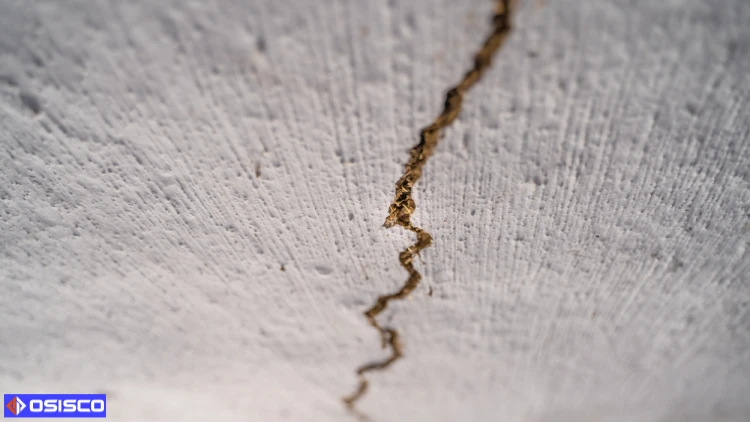
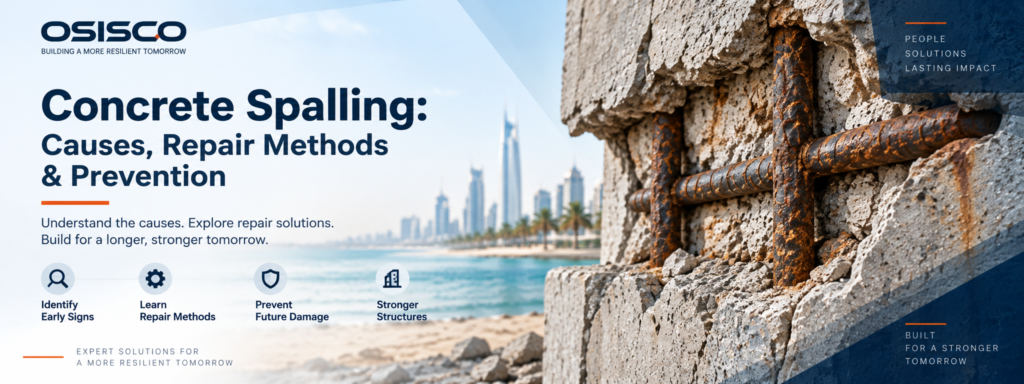
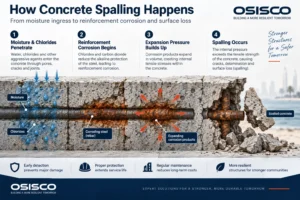
Concrete spalling involves the breaking chipping or flaking of the concrete surface, exposing coarse aggregate and reinforcing steel. While technical literature links early distress to cold-climate freeze-thaw damage, freeze-thaw cycling, and standard freeze-thaw deterioration, structural assets in Saudi Arabia and the GCC encounter intense heat and airborne chlorides. Under these harsh conditions, chloride ingress triggers active reinforcement corrosion. As oxidizing steel expands, internal tensile stresses cause spalling concrete. Ongoing reinforcement corrosion progressively reduces cross-sectional load-bearing capacity and depassivates structural rebar, leaving critical elements vulnerable to premature failure
Common Types of Spalling: Surface, Popouts, Corner, and Delamination
The International Concrete Repair Institute (ICRI) classifies spall geometry by depth and severity across the concrete matrix. Shallow popouts and localized surface flaking stem from aggregate expansion or finishing defects, classified as minor surface spalling. Structural corners fracture along exposed column edges, while thermal movement induces joint spalling along slab interfaces. Crucially, internal planar fractures develop within the concrete before outward surface breakout occurs. This hidden subsurface spalling, or delamination, represents dangerous horizontal separation. Identifying how concrete spalling manifests determines correct structural remediation
How to Detect and Inspect for Early Signs of Spalling
Managing spalling risk requires systematic diagnostics. Qualified inspectors identify rust trails and map hollow planes using acoustic hammer sounding before visible cracking and spalling manifests. Early detection of spalling in concrete allows asset managers to implement preventative and repair measures, such as applying protective barriers or sealing concrete decks to halt moisture intrusion. Timely intervention for concrete spalling mitigates structural decay. Proactively addressing concrete spalling protects critical built assets across the region
Causes and High-Risk Factors for Concrete Spalling
Rebar Corrosion and Oxide Jacking
Oxide jacking is among the primary causes of spalling in reinforced concrete structures. Electrochemical oxidation of embedded steel generates expansive corrosion products that occupy several times the volume of original metal. This radial expansion exerts immense internal tensile pressure within the concrete. Once these outward forces surpass the tensile capacity of nominal concrete cover, longitudinal cracking and progressive delamination occur, ultimately fracturing the matrix and detaching brittle sections of spalling concrete from the host element
Environmental Factors: Freeze-Thaw Cycles and De-icing Salts
According to Federal Highway Administration (FHWA) research, hydraulic pressures generated during freeze-thaw damage readily fracture saturated porous matrices. In cold regions subject to freeze-thaw cycles the use of de-icing salts accelerates surface scaling and aggregate pop-outs. Conversely, across Arabian Gulf and Red Sea coastal environments, extreme solar radiation and thermal cycling weaken the concrete over time. Coupled with airborne chlorides, this thermal distress accelerates reinforcement depassivation, triggering extensive concrete spalling even without sub-zero freezing temperatures
Poor Construction Practices and High-Risk Exposure Areas
Subpar workmanship and deficient construction practices significantly elevate structural vulnerability. High water-cement ratios, improper vibration, or inadequate curing produce weak surface layers susceptible to premature cracking. When an uncompacted surface layer allows aggressive chemicals to penetrate deep fissures, reinforcement deteriorates rapidly. Under the Saudi Building Code (SBC), identifying areas at higher risk of spalling in marine pilings, coastal substructures, and industrial slabs requiring foundation repair ensures targeted engineering mitigation against catastrophic concrete spalling
Concrete Spalling Repair Methods and Solutions
Assessment, Surface Preparation, and Corrosion Treatment
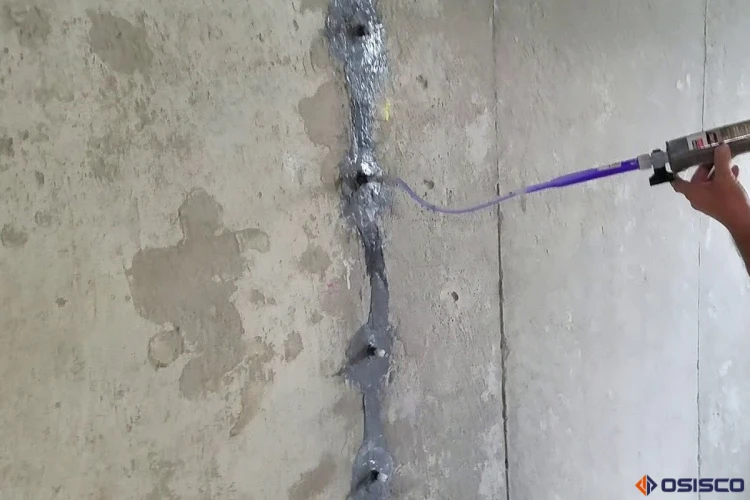
When addressing spalling concrete across critical concrete structures or an industrial concrete pavement, engineers evaluate repair options to prevent and repair concrete spalling. Following ICRI guidelines and civil engineering standards, specialists execute the concrete repair method to repair spalling by saw-cutting straight, right-angled perimeters and concrete is removed to expose sound substrate and provide adequate access around corroded reinforcement, in accordance with the specified repair system.
showing active corrosion. Abrasive-blasting exposed steel to bright metal and applying migratory corrosion inhibitors halts the electrochemical corrosion process to stop corrosion before reinstating spalled concrete
Partial-Depth vs. Full-Depth Concrete Repairs
Selecting proper spalling repair options depends on structural load limits and the overall structural integrity of the concrete. Localized surface defects utilize a partial-depth repair and a shrinkage-compensated, polymer-modified concrete mix to restore the surface and transfer compressive stress. However, when rebar cross-section loss exceeds safety limits or through-slab delamination occurs, engineers mandate full-depth repair or replacement rather than superficial surface patching
Cathodic Protection and Specialized Repair Materials
In chloride-contaminated concrete, sacrificial galvanic zinc anodes eliminate the halo effect, mitigating incipient anodes that initiate new corrosion in adjacent parent material. Specifying a high-performance repair using high-quality repair mortars, ensures long-term chemical and mechanical compatibility. Installing an engineered, polymer-modified repair mortar supports comprehensive concrete repair and prevention against recurring concrete spalling
Common Reasons Partial-Depth Repairs Fail
A partial-depth repair frequently fails when feather-edged cuts or incompatible repair mortars debond from the host concrete surface due to differential thermal expansion. Trapped moisture within untreated microcracks accelerates the risk of freeze-thaw damage and subsequent spalling, raising overall susceptibility to spalling on exposed concrete surfaces. Neglecting durable concrete repair protocols or failing when applying surface sealants leaves spalled concrete surfaces vulnerable, increasing the risk of recurrent spalling and severe concrete spalling
Measures to Prevent Concrete Spalling
Mitigating concrete spalling requires proactive engineering controls across structural design, concrete placement, and long-term facility asset maintenance stages
Proper Installation, Curing, and High-Quality Mix Selection
Engineers can prevent spalling during construction by specifying dense, low-permeability mixes featuring low water-cement ratios and supplementary cementitious materials such as silica fume or fly ash. Adhering to rebar cover standards governed by the American Concrete Institute (ACI) and Saudi Building Code (SBC) is vital, as Federal Highway Administration (FHWA) research shows cracks wider than 0.3 mm accelerate moisture and chloride ingress. In the GCC, strict wet curing protocols are essential to counter high ambient evaporation rates that otherwise trigger rapid plastic shrinkage cracking and weak surface layers
Protective Sealers, Waterproofing, and Barrier Coatings
Applying silane or siloxane penetrating sealers, hydrophobic impregnations, and elastomeric barrier coatings shields concrete surfaces from severe moisture, chlorides, and intense UV exposure. Because environmental weathering degrades topical barriers over time, these protective systems require planned substrate preparation and periodic re-application schedules rather than being treated as permanent solutions
Proactive Maintenance and Routine Inspection Protocols
Sustaining long-term structural health involves systematic inspection routines, including acoustic sounding surveys, joint rehabilitation, and timely crack sealing. Integrating these diagnostic surveillance practices into asset management repair specifications ensures localized delaminations are corrected well prior to visible breakout
Frequently Asked Questions About Concrete Spalling
Is Concrete Spalling Dangerous to Structural Integrity?
Concrete spalling can range from localized surface deterioration to damage that affects reinforcement and structural performance. The level of risk depends on the depth and extent of deterioration, the condition of the reinforcement, and the structural member involved. Spalling on overhead slabs, beams, columns, or facades can also create falling-debris hazards even when the underlying structural capacity has not yet been significantly affected.
What Is the Difference Between Concrete Delamination and Spalling?
Concrete delamination represents an internal, planar separation occurring parallel to the concrete surface, whereas spalling is the physical detachment and loss of that separated material. Delaminations are subsurface fractures that cannot be confirmed visually; technicians detect them across concrete surfaces using acoustic sounding methods, such as chain dragging or sounding hammers, to locate hollow voids. If untreated, internal expansion forces the detached layer to break away, leaving an open, jagged cavity characteristic of spalled concrete
How Quickly Does Concrete Spalling Spread If Untreated?
Deterioration accelerates once cover concrete is breached. Unprotected rebar corrodes at rapid rates, creating expansive rust stresses that crack adjacent sound material. Environmental exposures also accelerate deterioration; deicing salts and persistent moisture penetration reliably cause spalling across exterior slabs. In cold climates, frequent freeze-thaw cycles cause spalling to spread rapidly. Cold weather forces water trapped within the concrete to freeze and expand by roughly, generating internal tensile forces during seasonal freeze-thaw cycles. Subsequent freeze-thaw cycles further widen internal microcracks, making proactive intervention essential for preventing concrete spalling across vulnerable structures
When Can Spalling Be Repaired vs. Requiring Full Replacement?
Whether to patch or reconstruct depends on structural engineering standards and International Concrete Repair Institute (ICRI) guidelines. Localized patch repair may be appropriate when deterioration is limited and the remaining reinforcement is structurally adequate. Where significant reinforcement section loss or structural damage is present, a qualified structural assessment is required.. Technicians chip behind exposed rebar, clean or splice steel, and apply compatible repair mortars. Conversely, full-depth section replacement is mandatory when rebar section loss compromises structural load capacity or pervasive chloride contamination penetrates the entire structural element. In such cases, mere patch repairs fail at preventing spalling elsewhere, requiring engineers to replace the defective member and stabilize adjacent spalling concrete to restore ultimate capacity. This strategy halts concrete spalling across the entire structural bay.
Need Expert Help?
Our engineers respond within 24 hours. Free site assessment included.
Request Assessment →